I Built My Own AI Assistant — And I’m Not a Tech Expert
AI, Simple Online Income, Beginners
How I Discovered That Ordinary People Can Build Their Own Helpful AI Tools
You don't need to be a programmer, a tech expert or someone who understands everything about AI to make it useful.
I'm certainly not any of those things.
I'm someone who started exploring AI, learned by asking questions and experimenting, and gradually discovered that technology I once knew very little about could help me turn ordinary ideas and experience into something genuinely useful.
And somewhere along the way, I did something I wouldn't have imagined at the beginning:
I built my own AI assistant.
If you're a beginner, approaching retirement, or simply wondering whether AI could help you create a little extra income online, I hope my experience shows you that you don't have to know everything before you begin.
I Didn't Start as an AI Expert
My journey with AI hasn't involved learning complicated code or suddenly becoming a technical genius.
It's been much simpler than that.
I started by using AI and asking it questions.
Sometimes I wanted help understanding something. Sometimes I needed ideas. Other times I wanted to turn something complicated into steps I could actually follow.
And I've certainly had moments where things didn't work first time.
I've clicked the wrong thing. I've had to go back and change things. I've asked the same question in a different way when I didn't understand the first answer.
But that's actually how I learned.
Instead of needing to understand the technology behind AI, I discovered I could simply have a conversation with it.
And the more I used it, the more possibilities I began to see.
What an AI Assistant Can Actually Help You Do
One of the things I like most about AI is that it can take something that feels complicated and help break it into manageable pieces.
For example, you can use AI to:
Organise what you already know. Notes, ideas, recipes, experience or even a jumble of thoughts can become a checklist, guide or step-by-step plan.
Help create content. It can help turn your ideas into blog posts, emails, social media content or digital guides without you having to stare at a blank page.
Explain things simply. If something feels technical or confusing, you can ask AI to explain it in everyday language.
Develop ideas. Something that starts as a vague thought can become a product idea, content plan or practical project.
Create helpful AI assistants. Your own knowledge and instructions can be used to create an assistant designed to help with a particular subject or problem.
That last one was a particularly important discovery for me.
I realised the AI didn't need to replace what I knew.
What I knew was the valuable part.
AI could simply help me organise it, develop it and make it easier to share with somebody else.
You Don't Need Advanced Technical Skills to Start
This is probably the part I'd most like other beginners to understand.
You do not need to know how to code to start using AI.
If you can type a question into a box, read the answer and say:
"That's not quite what I meant — can you change this?"
…you've already got one of the most important skills.
You're communicating.
Think about all the things you've learned during your life.
Perhaps you've trained somebody at work, shown a friend how to do something, taught a child, followed instructions, solved problems or explained something you understand to somebody who doesn't.
Working with AI isn't so different.
You tell it what you're trying to achieve. It responds. You decide whether the answer is useful. Then you correct it, refine it or ask another question.
You don't need to know everything. You just need to be willing to ask.
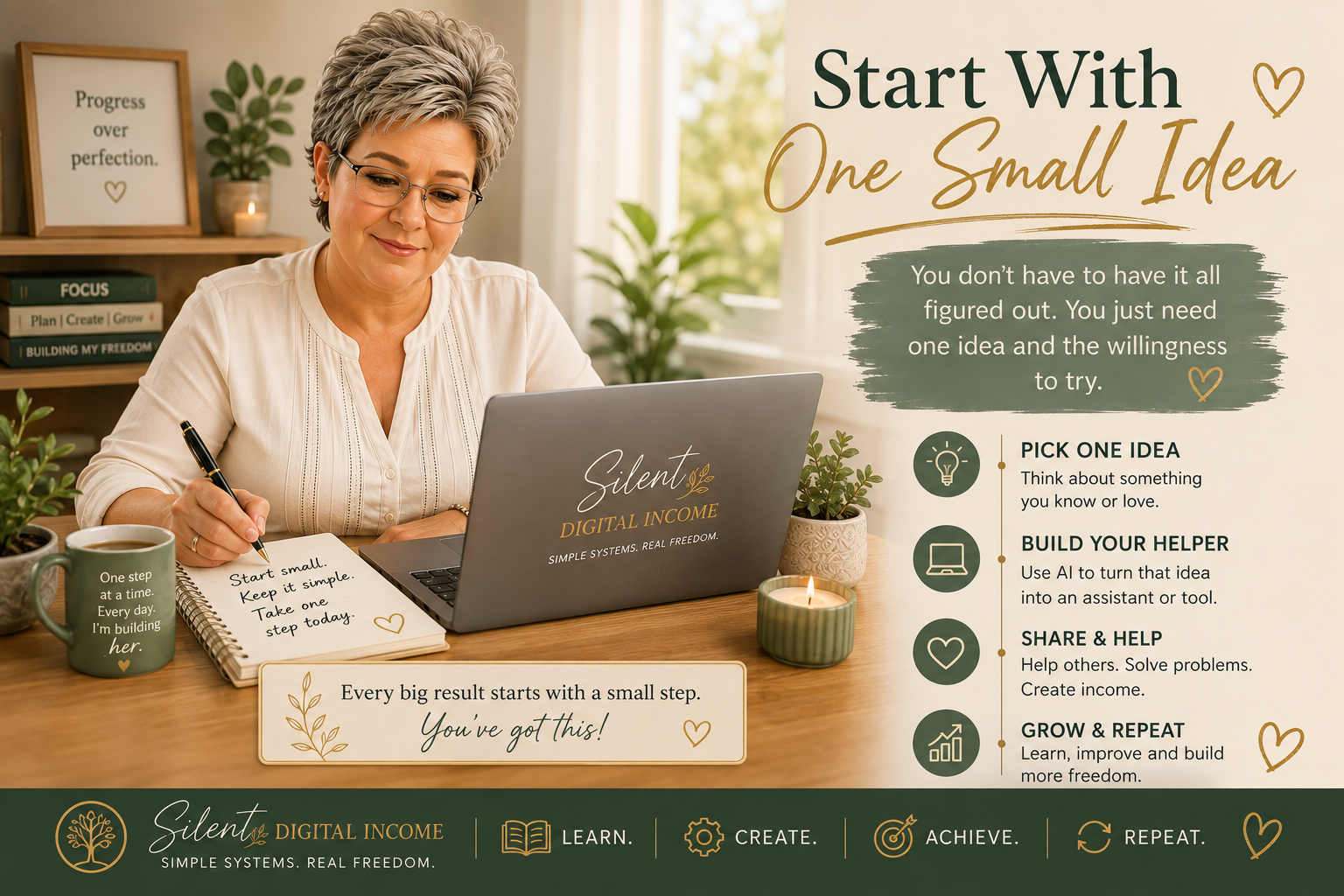
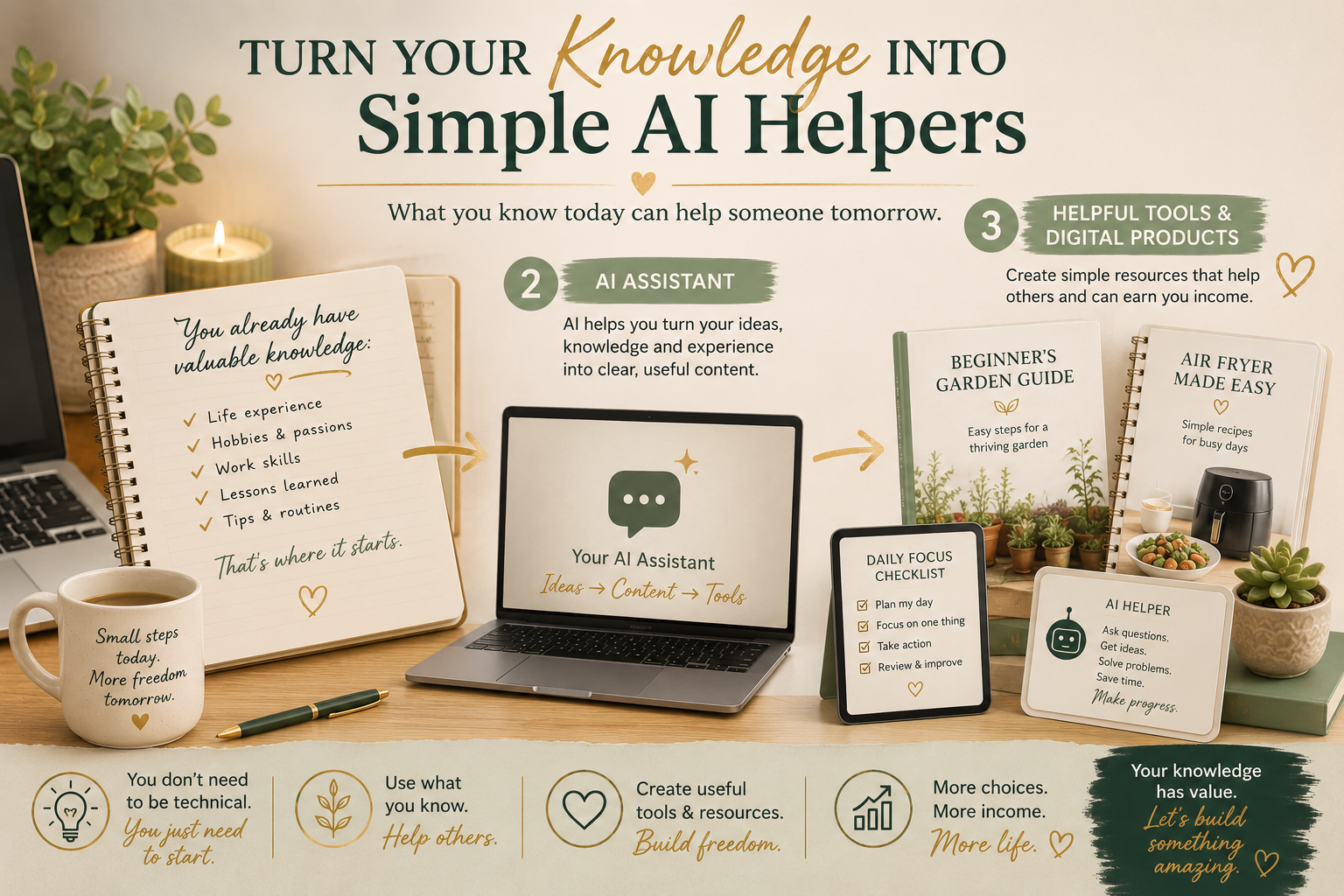
Your Ordinary Knowledge May Be More Valuable Than You Think
This was one of the biggest shifts for me.
When people talk about creating something online, it's easy to think:
"What could I possibly teach anyone?"
But knowledge doesn't have to be extraordinary to be useful.
Something you've done for years without thinking about it could be exactly the thing somebody else is struggling to learn.
You might know about gardening, cooking, organising family holidays, caring for pets, working shifts, budgeting, crafts, paperwork or hundreds of other everyday subjects.
Imagine turning that knowledge into:
a simple beginner's guide;
a checklist;
a small digital product;
a collection of useful prompts;
or an AI helper that answers questions about that subject.
That's where AI becomes particularly interesting.
Instead of asking, “What can AI create for me?”, I've learned it's often better to ask:
“What do I already know that AI could help me turn into something useful?”
That's a very different starting point.
I Put This Into Practice Myself
Eventually, I stopped simply learning about what AI could do and decided to create something of my own.
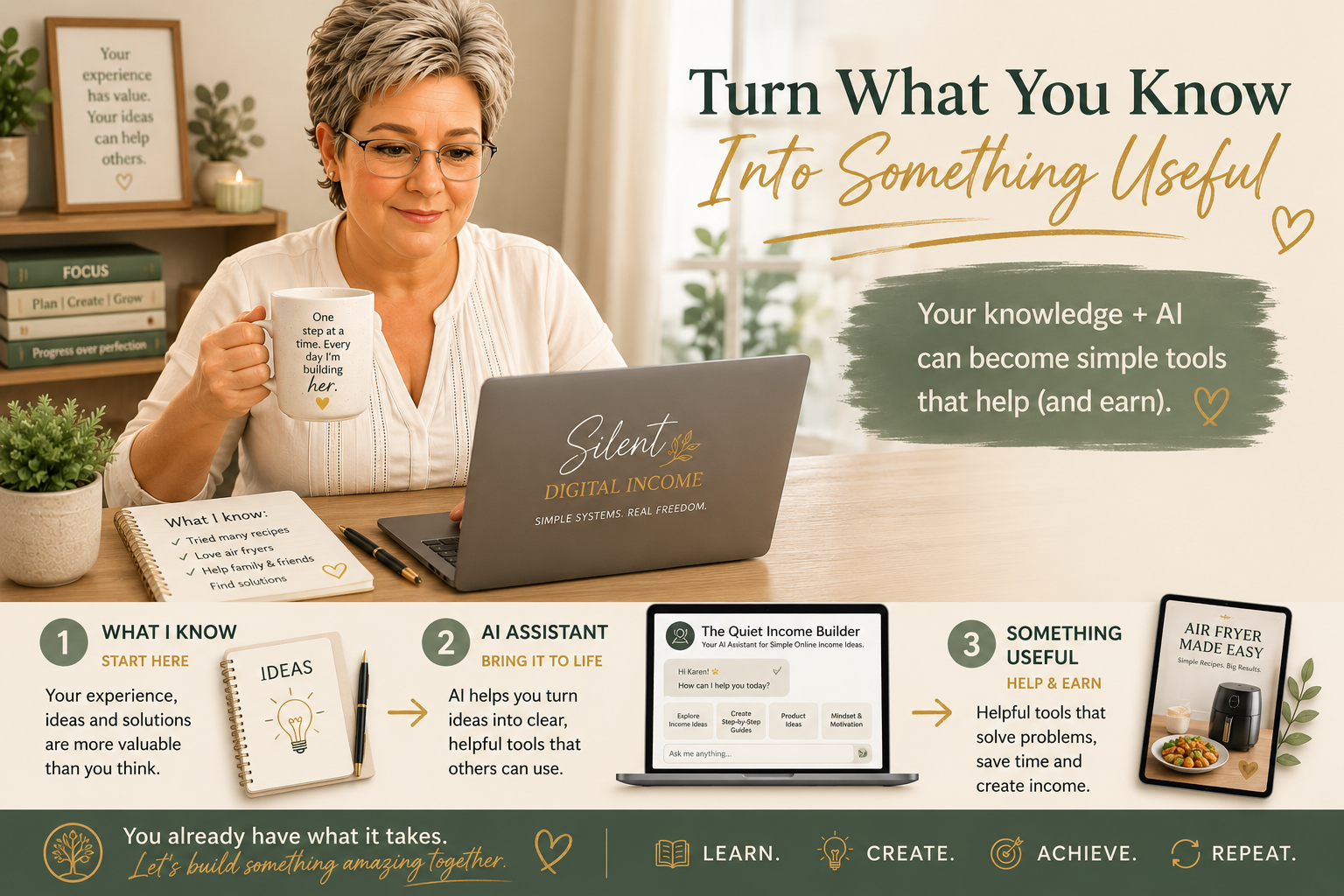
I built The Quiet Income Builder, an AI assistant designed to help beginners explore simple online income ideas without making the whole process feel overwhelming.
I didn't sit down one morning magically knowing how to build it.
It developed through conversations, instructions, testing and plenty of adjusting.
I'd try something.
See what happened.
Change what didn't work.
Then try again.
And that's one of the reasons I believe ordinary people can use this technology.
Because I'm doing it myself.
I'm still learning too.
A Simple Way to Find Your First AI-Based Idea
If you'd like to explore what you could create, don't start by trying to invent the next huge technology company.
Start small.
1. Pick something you know about.
It could come from your work, a hobby, something you've experienced or simply something friends regularly ask you for help with.
2. Write down what you know.
Don't worry about making it polished. Think about the questions beginners ask, mistakes you've made, shortcuts you've discovered and advice you'd give someone starting today.
3. Ask AI to help organise it.
You could simply type:
"I know quite a lot about [your subject]. Help me identify ways I could turn this knowledge into something useful for a beginner."
See what comes back.
4. Choose one small idea.
Not ten. Just one.
Perhaps it's a checklist, mini guide, prompt collection or simple AI helper.
5. Build, test and improve it.
Your first attempt doesn't have to be perfect. Mine certainly wasn't.
The important bit is starting.
What If You Still Feel Intimidated by AI?
Then start even smaller.
Open an AI assistant and type:
“I'm completely new to AI. Please explain what you can help me with in simple, everyday language.”
That's it.
You don't need to pretend you understand terminology you don't understand.
Ask questions.
If the answer is confusing, say so.
If you want instructions one step at a time, ask for them one step at a time.
I do.
There is no prize for making technology harder than it needs to be. 😄
Confidence doesn't usually arrive before we try something.
It tends to grow because we tried it, survived the mistakes and discovered we could do a little more than we thought.
If you're wondering how to take that first step towards earning online, I've also put together a simple guide to getting started when you don't know where to begin.
Want to Try Building Your Own AI Assistant?
If reading this has made you curious about creating your own AI helper, you don't have to work everything out from scratch.
One of the resources I've used is the Build-a-Bot Playbook, which takes you through the process of creating your own AI assistant step by step.
It's particularly useful if you're looking at all this thinking:
"That sounds interesting…but where on earth would I start?"
That's exactly the sort of gap a step-by-step guide can help bridge.
👉 Take a look at the Build-a-Bot Playbook here
Disclosure: This is an affiliate link, which means I may receive a commission if you purchase through my link, at no additional cost to you. I only share resources I believe may be useful to my audience.
One Last Thing
I'm not building Silent Digital Income because I have all the answers.
I'm building it while I'm learning.
And that's rather the point.
I want to show that you don't need to be twenty-five, technically brilliant or already running a successful online business to start exploring what's possible.
You can begin with the knowledge and experience you already have.
Then use AI to help you turn it into something useful.
You bring the experience, ideas and human judgement. AI helps you organise, create and move a little faster.
And sometimes the thing you thought was “just something I know” might turn out to be exactly what somebody else needs.
Learn. Create. Achieve. Repeat.