7 Things You Already Know That Could Become a Simple Digital Product
AI, Simple Online Income, Beginners
7 Things You Already Know That Could Become a Simple Digital Product
You may already have the knowledge for a digital product — even if you don’t think of yourself as an expert. Here are seven places to look.
One of the hardest questions when you're thinking about earning online isn't always:
“How do I make money?”
Sometimes it's:
“What on earth do I know that anybody would pay for?”
I understand that feeling.
When you've done something for years, it can seem completely ordinary. You forget there was once a time when you didn't know how to do it either.
Maybe you know how to grow tomatoes without killing them.
Perhaps you're the person everyone asks to organise a family holiday.
You might have spent years dealing with paperwork, managing a household, cooking for a family, working in a particular industry or enjoying a hobby you've quietly become rather good at.
None of that necessarily feels like “expert knowledge”.
But to somebody starting from scratch?
It can be exactly the help they're looking for.
And with tools such as AI making it much easier to organise what we know, that everyday experience can become the starting point for a checklist, guide, planner, template or other simple digital product.
Here are seven places I'd start looking.
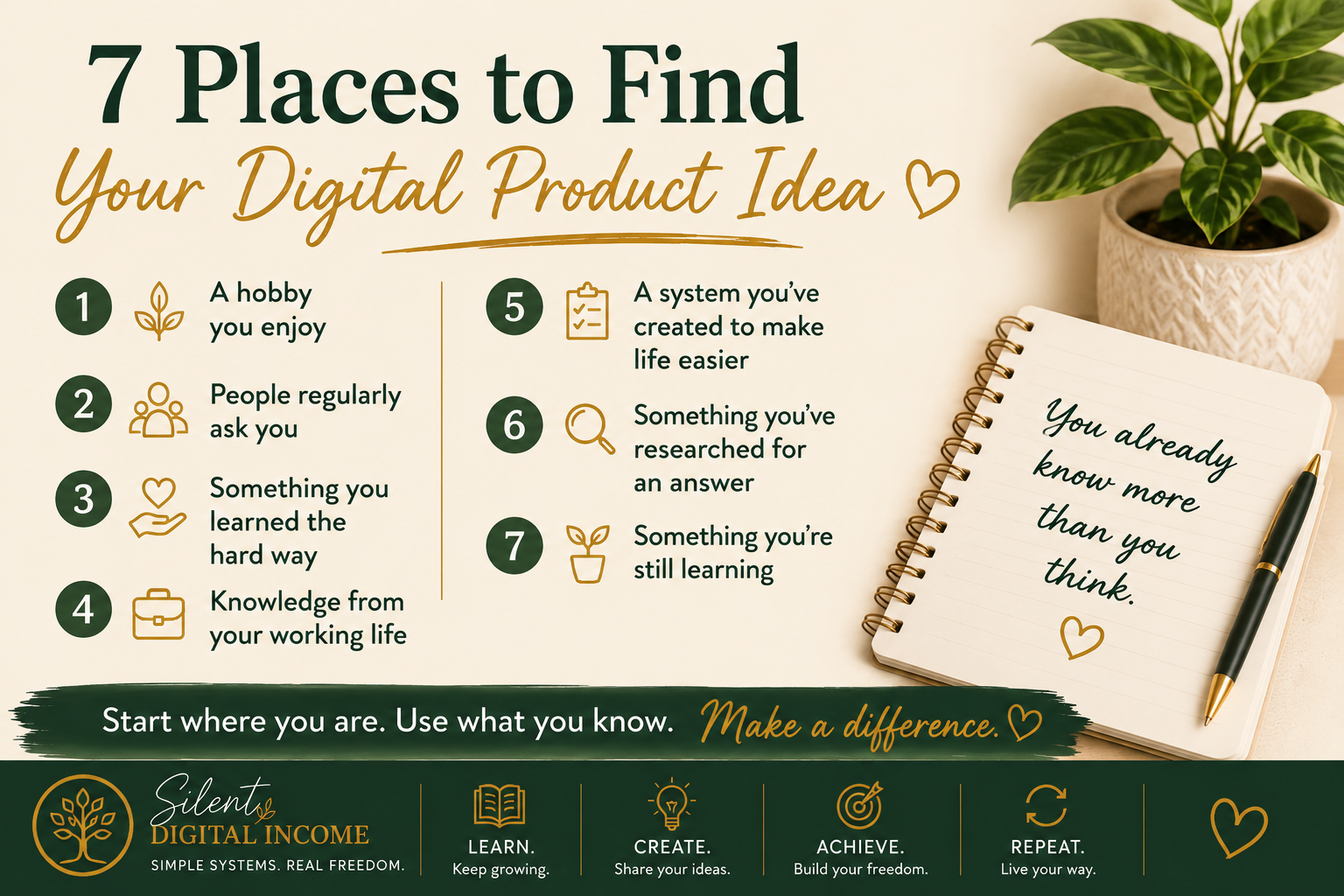
1. A Hobby You've Enjoyed for Years
Think about the things you do because you enjoy them.
Gardening. Knitting. Crochet. Baking. Photography. Crafts. Walking. DIY. Growing vegetables. Family-history research.
You probably know considerably more than somebody trying it for the first time.
And that's the important bit.
You don't need to create The Complete Guide to Gardening.
You could create:
“My Beginner's Guide to Growing Vegetables in Containers.”
Or:
“10 Things I Wish I'd Known Before Learning to Crochet.”
Small and specific is often much more useful than trying to teach absolutely everything.
Ask yourself:
What do beginners always seem to struggle with in my hobby?
There's your first clue.
2. Something People Regularly Ask You for Help With
This is one of my favourites because sometimes other people recognise our useful knowledge before we do.
What do friends, relatives or colleagues ask you about?
Maybe it's:
planning holidays
using a particular piece of technology
filling in forms
organising family events
cooking a certain meal
caring for plants
finding bargains
creating spreadsheets
using an air fryer
If you repeatedly hear:
“How did you do that?”
or
“Can you show me how?”
pay attention.
You might already be solving a problem that other people have.
And problems are often where good digital-product ideas begin.
3. Something You Had to Learn the Hard Way
Not everything valuable comes from qualifications.
Sometimes the most useful knowledge comes from having been through something yourself and discovering what works.
Perhaps you had to learn how to organise a house move.
Maybe you've discovered how to plan meals around long shifts.
Perhaps you spent hours researching something that you can now explain to another beginner in ten minutes.
Think about the information you wish someone had handed you before you started.
That could become:
a checklist, a simple planner, a “things to know before you start” guide, a resource list or a step-by-step PDF.
You're not claiming to know everything.
You're simply helping the next person avoid some of the confusion you experienced.
4. Knowledge From Your Working Life
This one is very easy to overlook.
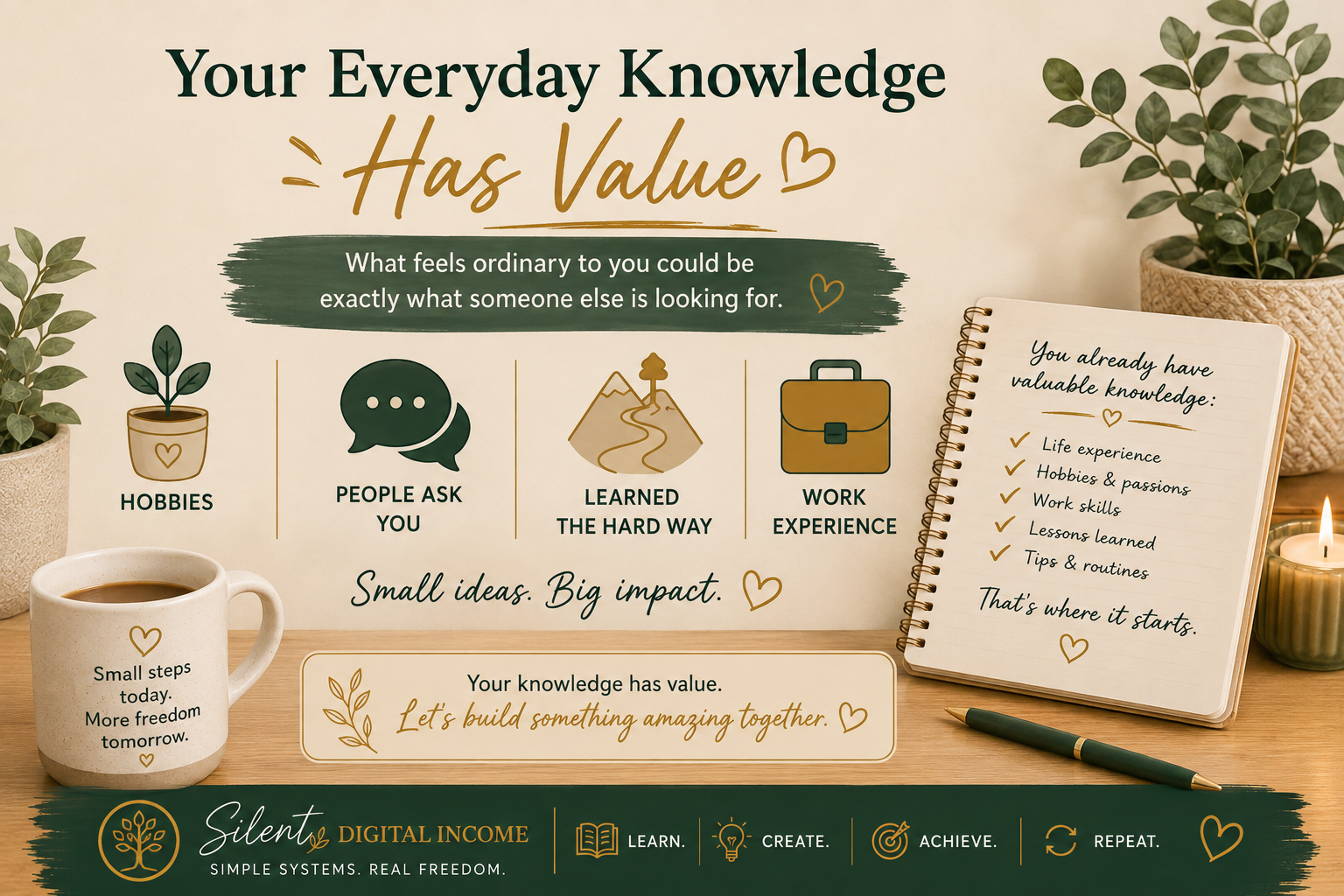
If you've spent 10, 20, 30 or even 40 years working, you've accumulated knowledge without really noticing it.
You might understand:
customer service, shift work, administration, logistics, training new employees, spreadsheets, stock control, scheduling, workplace organisation or dozens of other things.
Obviously, that doesn't mean sharing confidential information from an employer.
It means asking:
“What general skills has my working life taught me that could help somebody else?”
For example, someone who has trained new staff for years might be excellent at breaking complicated tasks into beginner-friendly steps.
That's a valuable skill in itself.
5. A System You've Created to Make Life Easier
This doesn't have to be revolutionary.
In fact, simple is good.
Maybe you've developed your own:
weekly meal planner, holiday packing checklist, household cleaning routine, budgeting sheet, Christmas organiser, garden planner or daily routine.
You created it because you needed it.
There's a fair chance somebody else needs something similar.
A useful digital product doesn't always have to teach.
Sometimes it simply helps somebody become more organised.
And a printable checklist or template that saves someone an hour of frustration can be surprisingly valuable.
6. Something You've Researched Because You Needed an Answer
Have you ever fallen down one of those internet rabbit holes?
You start with one question and three hours later you've got 17 browser tabs open. 😂
We've all done it.
But once you've gathered that information, compared the options and worked out what actually matters, you've done something useful:
you've simplified the research.
That could potentially become a beginner resource.
The important thing here is knowing your boundaries.
For subjects involving health, law, finance or other professional advice, you need to be particularly careful about what you claim and make clear when professional guidance is required.
But there are plenty of everyday subjects where organising publicly available information into an easy starting point can be genuinely helpful.
7. Something You're Still Learning
This one surprised me.
You don't necessarily have to wait until you've mastered something before you can create useful content around it.
I'm doing this myself with AI.
I'm not pretending I've spent decades working in artificial intelligence.
I haven't.
I'm learning, experimenting, asking questions, building things and sharing what I'm discovering from the perspective of somebody who didn't start as a technical person.
And that perspective can actually be useful to another beginner.
Someone ten steps ahead may be an expert.
But sometimes the person only two steps ahead remembers exactly what step one felt like.
You can document what you're learning, share your mistakes and explain things in language another beginner understands.
That's valuable too.
What I knew was the valuable part.
AI could simply help me organise it, develop it and make it easier to share with somebody else.
But Would Anybody Actually Pay for Something I Know?
Maybe.
And maybe not yet.
I wouldn't start by worrying about the price.
I'd start by asking whether you can create something that genuinely makes another person's life easier, quicker, clearer or less overwhelming.
That's a much better question.
Your first idea could even be something you give away for free.
That lets you discover whether people are interested before spending weeks creating a large product nobody asked for.
Start small.
Test.
Listen.
Improve.
Then build from there..
Where AI Fits Into All of This
This is the part I find particularly exciting.
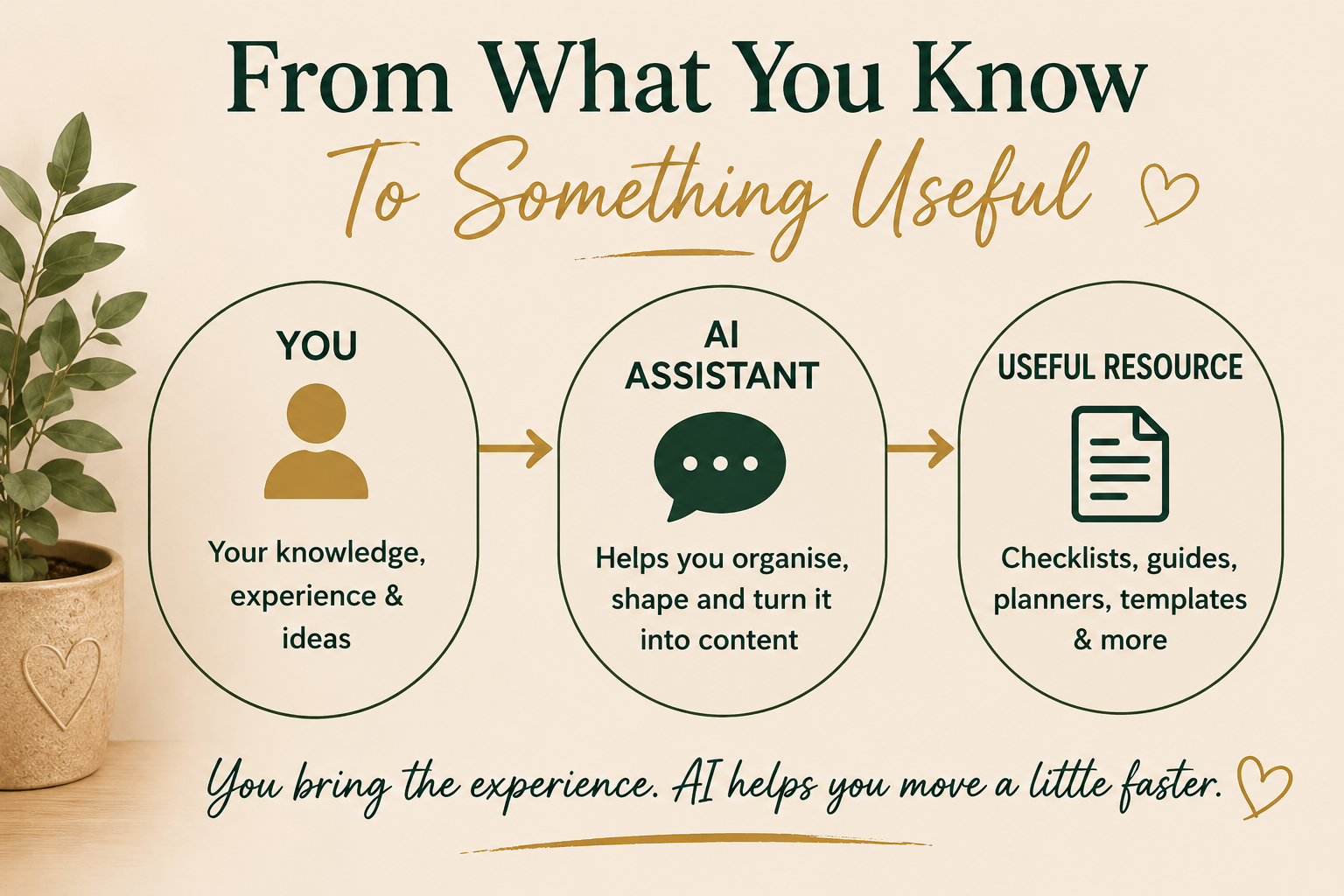
You don't have to sit staring at a blank document wondering how to turn everything in your head into something organised.
You can tell an AI assistant:
“I know quite a lot about growing vegetables in containers. Ask me questions to help me identify what would be useful to a complete beginner.”
Then answer its questions.
You could follow that with:
“Based on my answers, give me five small digital-product ideas I could create for beginners.”
Suddenly, you're not asking AI to invent a business for you.
You're using it to help uncover and organise the value that's already there.
That's a very different thing.
That same idea is what led me to discover that ordinary people can build their own helpful AI tools.
Try This Simple Exercise
Grab a piece of paper — or the notes app on your phone — and write these four headings:
I KNOW…
I'VE LEARNED…
PEOPLE ASK ME ABOUT…
I ENJOY…
Don't overthink your answers.
Write down anything that comes to mind.
Then look for overlaps.
Something you know + enjoy + other people need help with is particularly interesting.
You may discover that you've got far more potential ideas than you expected.
You Don't Need the Perfect Idea
This is probably the bit I'd most like you to remember.
You don't need to discover your million-pound idea this afternoon.
You need one small idea worth exploring.
That's all.
Your years of work, hobbies, mistakes, interests and life experience haven't left you empty-handed.
They've given you a rather large library.
AI can help you search through that library, organise what you find and perhaps turn a little piece of it into something useful for somebody else.
The technology isn't the valuable bit on its own.
What you bring to it matters too.
And if you're sitting there thinking:
“I still haven't got a clue what mine could be…”
that's absolutely fine.
I've created a free AI Assistant Starter Guide to give you a simple place to begin exploring what AI can help you do.
🎁 Get the FREE AI Assistant Starter Guide
No coding. No technical background required. Just curiosity and a willingness to start small.
One Last Thing
I'm not building Silent Digital Income because I have all the answers.
I'm building it while I'm learning.
And that's rather the point.
I want to show that you don't need to be twenty-five, technically brilliant or already running a successful online business to start exploring what's possible.
You can begin with the knowledge and experience you already have.
Then use AI to help you turn it into something useful.
You bring the experience, ideas and human judgement. AI helps you organise, create and move a little faster.
And sometimes the thing you thought was “just something I know” might turn out to be exactly what somebody else needs.
Learn. Create. Achieve. Repeat.